
|
|
|
|
June 2026 .. this section provides an interactive iVDA map and table showing state and city population from 2020 to 2025 intended for introductory and more advanced users. Marketing to the right demographic might be improved by using up-to-date measures for city population by age. Of the nation's 341,784,857 people in 2025, an estimated 215,662,427 (63.1%) live within an incorporated city (19,484). Of these cities, about 75 percent had fewer than 5,000 people and roughly 47.3 percent had fewer than 1,000 people. See correspoonding CountyTrends population and components of change interactive table. Topics in this Section • Interactive Maps of Cities & Counties with iVDA Additional Views • Interactive Table Related Sections • City Trends 2020-25 (19,484 areas) .. this page • County Trends 2020-25 (3,144 areas) • Metro Trends 2020-25 (925 areas) Interactive Mapping with iVDA .. goto top .. The starting view shows a zoom-in view of central Texas by city. .. login (blue button above map) within 10 minutes from start of map display .. no cost. .. iVDA part of Visual Data Analytics .. about VDAGIS below .. iVDA works on any device; iPhone (not recommended due to screen size) .. iVDA is an iframe version of VDA Web GIS4 ..open related VDA Web GIS4 Join us in the weekly data analytics web sessions where CityTrends topics are included. Additional City Views .. goto top Larger U.S. Cities; 250k and Over; 2025 .. this view shows cities using points as markers to represent cities. .. how many cities can you name? .. click graphic for larger view with city names. 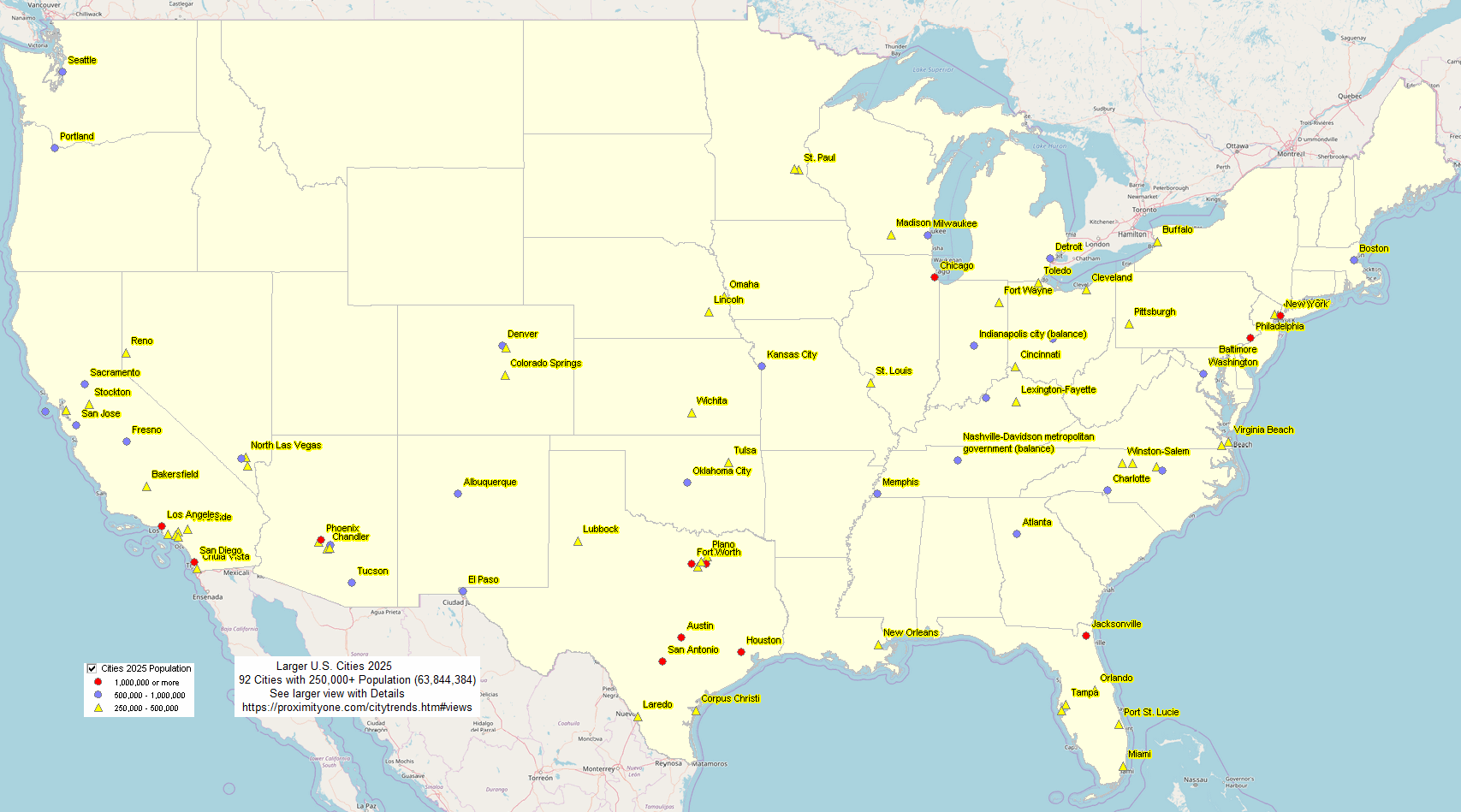
Or, use the interactive mapping GIS version: City Population Estimates & Trends Interactive Table: 2020-2025 .. goto top See usage notes below ranking table. Rank on any column by clicking column header; use mouse-over on column header to view description of item. .. use buttons below table for selective columns view. Data Source and Methodology • Data Source • Methodology Usage Notes • Click ShowAll between queries/filters. • Use left-most column to select by state. • Find in Name button; click ShowAll button first .. click Find in Name button to search column 1 for text in edit box. .. text entered in edit box is case sensitive. .. partial names are okay to use. .. click with default value to view all rows with "Houston" (no quotes) • Find in StCity button; click ShowAll button first .. click Find in STCity button to search column 7 for text in edit box. .. text entered in edit box must be the 5-character state+city code. .. click with default value to view all rows with "0465000" (no quotes) Selected columns buttons • Population Min & Max> button .. click to show only peer group counties based on values in min and max edit boxes. .. enter the minimum 2025 population in the left edit box. .. enter the maximum 2025 population in the right edit box. • Click ShowAll between queries/filters. Using the U.S. by Cities Shapefile with Integrated Demographics .. goto top The U.S. by city/place shapefile is developed/updated annually as part of the Census Bureau TIGER/Line digital map database. It is the most authoritative and up-to-date source of annually updated incorporated city boundaries. ProximityOne integrates the city population annual time series estimates into the smoothed version of the national U.S. by place shapefile. About These Data -- goto top City and sub-county population estimates are developed annually by the Census Bureau. The model-based estimates are normally released in July (e.g., 7/1/26 estimates released in July 2026). Population estimates for incorporated places the city with boundaries as defined as of January 1, 2025. Incorporated Cities/Places The legal designations, powers, and functions of incorporated places vary from state to state. Incorporated places include cities, towns (except in New England, New York, and Wisconsin where towns are county administrative subdivision), boroughs (except in Alaska where boroughs are treated as equivalents of counties and New York where five boroughs comprise New York City) and villages. Incorporated places can cross both county boundaries. ProximityOne assigns each city to a county and CBSA/metro (if located in a CBSA). The county is assigned using a U.S. by city point shapefile. The county is assigned to a city for the county that contains the city point (internal area latitude-longitude). The CBSA code is assigned based on the county code (all CBSAs are comprised of one of more counties). Data in Excel/Database Structure Data shown in the table are available in the form of Excel, CSV or DBF structure. Users of the shapefile (described above may use the dbf part of the shapefile for tabular/spread-type analysis and to integrate with other data. Support Using these Resources .. goto top Learn more about demographic economic data and related analytical tools. Join us in a Data Analytics Lab session. There is no fee for these Web sessions. Each informal session is focused on a specific topic. The open structure also provides for Q&A and discussion of application issues of interest to participants. ProximityOne User Group .. goto top Join the ProximityOne User Group to keep up-to-date with new developments relating to geographic-demographic-economic decision-making information resources. Receive updates and access to tools and resources available only to members. Use this form to join the User Group. Additional Information .. goto top ProximityOne develops geographic-demographic-economic data and analytical tools and helps organizations knit together and use diverse data in a decision-making and analytical framework. We develop custom demographic/economic estimates and projections, develop geographic and geocoded address files, and assist with impact and geospatial analyses. Wide-ranging organizations use our software, data and methodologies to analyze their own data integrated with other data. Contact ProximityOne (888-364-7656) with questions about data covered in this section or to discuss custom estimates, projections or analyses for your areas of interest. |
|
|
