
|
|
|
-- expanding insights through data analytics April 2023 .. In 2022, real GDP for the nation increased at an annual rate of 2.1 percent, with the percent change in real GDP ranging from 4.9 percent in Idaho to –2.4 percent in Alaska. Real GDP increased in 15 of the 23 industry groups. Professional, scientific, and technical services; information; and real estate and rental and leasing were the leading contributors to the increase in real GDP nationally. This section updates in late April 2023. E-mail us or call (888-364-7656) with questions/help. Gross Domestic Product (GDP) is a comprehensive measure of U.S. economic activity. This section provides access to annual GDP estimates for the period 2010 through 2018 and tools to analyze these data. The 2018 data are the latest estimates as of August 2019 (about these data). This section provides data and tools focused on the U.S. and states. See about related sections below. See corresponding U.S. & State Quarterly GDP; 2018-2019; 24 sectors. Patterns of Per Capita Real GDP & Percent Change by State The following graphic shows patterns of the 2018 per capita real GDP by state. The color patterns/intervals are shown in the inset legend. In the larger view (click graphic), states are labeled with 2018 per capita real GDP (white label) and percent change in per capita real GDP, 2010-2018. Click graphic for larger view. Expand browser to full window for best quality view. Use the GIS tools described below to develop thematic pattern map using any combination of these items from 2010 forward. 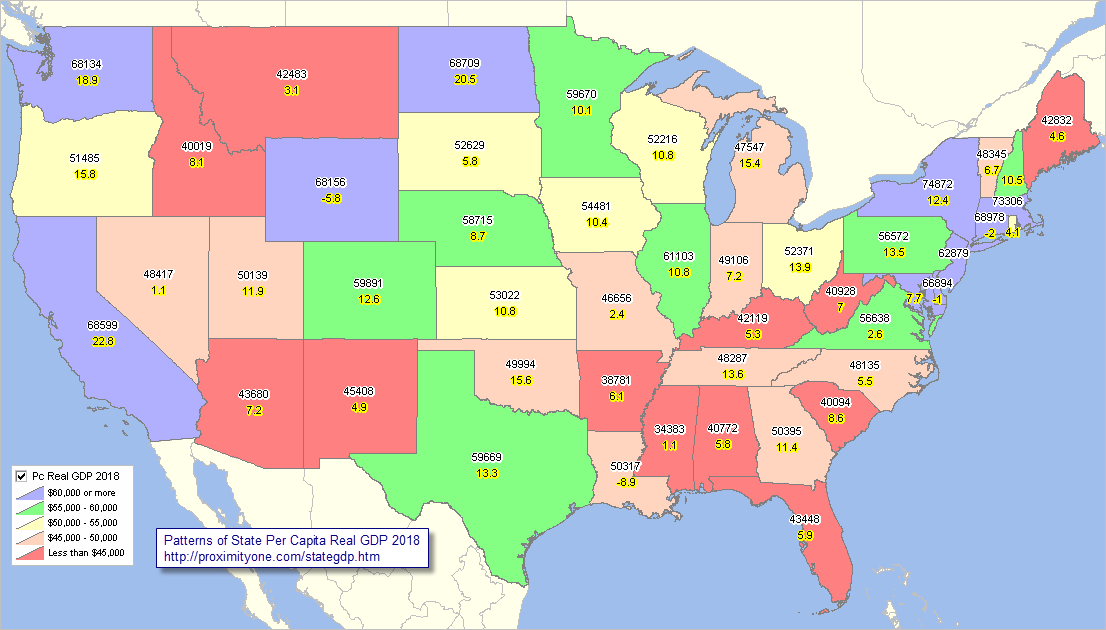 .. view developed using the CV XE GIS software. .. click map for larger view and details. Importance GDP is an important part of planning, management and decision-making in the private and public sectors. It is watched closely by all stakeholders as to how the economy is trending. By adjusting current dollar GDP to constant dollar GDP, we can better examine the trends and patterns by removing inflation from the measures. By examining GDP at the metro and sub-state area, businesses and policy-makers can better determine GDP patterns on a regional basis. Regional analysis of GDP is very important as magnitude and change vary widely. By examining the size and trends of regional real GDP on a per capita basis, we are better able to examine patterns and trends at the individual level. Modeling, Projections & Access/Analysis/Interpretive Tools GDP is an important part of the ProximityOne Situation & Outlook (S&O) estimates and projections. U.S. & State Real Gross Domestic Product by Industry/Sector; 2010-2018 .. interactive table .. goto top Use mouse-over on header column to view extended item/column name. Click ShowAll button between queries. See usage notes below table. Related ranking tables: interactive tables. Usage Notes Use mouse-over on header column to view extended item/column name. Click ShowAll button to reset table. Column Descriptions .. goto top
- Area Name
- USPS State abbreviation - States FIPS code - Region - Industry ID - Industry Group - Sector Name - Per Capita Real GDP 2010 - Per Capita Real GDP 2011 - Per Capita Real GDP 2012 - Per Capita Real GDP 2013 - Per Capita Real GDP 2014 - Per Capita Real GDP 2015 - Per Capita Real GDP 2016 - Per Capita Real GDP 2017 - Per Capita Real GDP 2018 - Per Capita Real GDP Ch 1017 - Per Capita Real GDP %Ch 1017 - Real GDP $M 2010 - Real GDP $M 2011 - Real GDP $M 2012 - Real GDP $M 2013 - Real GDP $M 2014 - Real GDP $M 2015 - Real GDP $M 2016 - Real GDP $M 2017 - Real GDP $M 2018 - POP10 - POP11 - POP12 - POP13 - POP14 - POP15 - POP16 - POP17 - POP18 Industries/Sectors Included .. goto top
- 01 All industry total
- 02 .Private industries - 03 ..Agriculture, forestry, fishing, and hunting - 04 ...Farms - 05 ...Forestry, fishing, and related activities - 06 ..Mining, quarrying, and oil and gas extraction - 07 ...Oil and gas extraction - 08 ...Mining (except oil and gas) - 09 ...Support activities for mining - 10 ..Utilities - 11 ..Construction - 12 ..Manufacturing - 13 ...Durable goods manufacturing - 14 ....Wood product manufacturing - 15 ....Nonmetallic mineral product manufacturing - 16 ....Primary metal manufacturing - 17 ....Fabricated metal product manufacturing - 18 ....Machinery manufacturing - 19 ....Computer and electronic product manufacturing - 20 ....Electrical equipment, appliance, and component manufacturing - 21 ....Motor vehicles, bodies and trailers, and parts manufacturing - 22 ....Other transportation equipment manufacturing - 23 ....Furniture and related product manufacturing - 24 ....Miscellaneous manufacturing - 25 ...Nondurable goods manufacturing - 26 ....Food and beverage and tobacco products manufacturing - 27 ....Textile mills and textile product mills - 28 ....Apparel, leather, and allied product manufacturing - 29 ....Paper manufacturing - 30 ....Printing and related support activities - 31 ....Petroleum and coal products manufacturing - 32 ....Chemical manufacturing - 33 ....Plastics and rubber products manufacturing - 34 ..Wholesale trade - 35 ..Retail trade - 36 ..Transportation and warehousing - 37 ...Air transportation - 38 ...Rail transportation - 39 ...Water transportation - 40 ...Truck transportation - 41 ...Transit and ground passenger transportation - 42 ...Pipeline transportation - 43 ...Other transportation and support activities - 44 ...Warehousing and storage - 45 ..Information - 46 ...Publishing industries (except Internet) - 47 ...Motion picture and sound recording industries - 48 ...Broadcasting (except Internet) and telecommunications - 49 ...Data processing, hosting, and other information services - 50 ..Finance, insurance, real estate, rental, and leasing - 51 ...Finance and insurance - 52 ....Monetary Authorities- central bank, credit intermediation, and related services - 53 ....Securities, commodity contracts, and other financial investments and related activi - 54 ....Insurance carriers and related activities - 55 ....Funds, trusts, and other financial vehicles - 56 ...Real estate and rental and leasing - 57 ....Real estate - 58 ....Rental and leasing services and lessors of nonfinancial intangible assets - 59 ..Professional and business services - 60 ...Professional, scientific, and technical services - 61 ....Legal services - 62 ....Computer systems design and related services - 63 ....Miscellaneous professional, scientific, and technical services - 64 ...Management of companies and enterprises - 65 ...Administrative and support and waste management and remediation services - 66 ....Administrative and support services - 67 ....Waste management and remediation services - 68 ..Educational services, health care, and social assistance - 69 ...Educational services - 70 ...Health care and social assistance - 71 ....Ambulatory health care services - 72 ....Hospitals - 73 ....Nursing and residential care facilities - 74 ....Social assistance - 75 ..Arts, entertainment, recreation, accommodation, and food services - 76 ...Arts, entertainment, and recreation - 77 ....Performing arts, spectator sports, museums, and related activities - 78 ....Amusement, gambling, and recreation industries - 79 ...Accommodation and food services - 80 ....Accommodation - 81 ....Food services and drinking places - 82 ..Other services (except government and government enterprises) - 83 .Government and government enterprises - 84 ..Federal civilian - 85 ..Military - 86 ..State and local - 87 Natural resources and mining - 88 Trade - 89 Transportation and utilities - 90 Private goods-producing industries - 91 Private services-providing industries - About these Data .. goto top GDP by state is the state counterpart of the U.S. Gross Domestic Product (GDP), the most comprehensive measure of U.S. economic activity. GDP by state is derived as the sum of the GDP originating in all the industries in a state. The Bureau of Economic Analysis develops estimates of GDP but does not develop projections of GDP or assess impact of changing GDP beyond what the estimates are telling us. The statistics of real GDP by state are prepared in chained (2012) dollars. Real GDP by state is an inflation-adjusted measure of each state's gross product that is based on national prices for the goods and services produced within that state. The statistics of real GDP by state and quantity indexes with a reference year of 2012 were derived by applying national chain-type price indexes to the current-dollar values of GDP by state for the 21 NAICS-based industry sectors. An industry's GDP by state, or its value added, is calculated as the sum of incomes earned by labor and capital and the costs incurred in the production of goods and services. It includes the wages and salaries that workers earn, the income earned by individual or joint entrepreneurs as well as by corporations, and business taxes such as sales, property, and Federal excise taxes—that count as a business expense. GDP is calculated as the sum of what consumers, businesses, and government spend on final goods and services, plus investment and net foreign trade. In concept, incomes earned should equal what is spent, but due to different data sources, the measurement of income earned (gross domestic income), does not always equal the measurement of what is spent (GDP). The difference is referred to as the "statistical discrepancy." GDP by state for the U.S. differs from the GDP in the national income and product accounts (NIPAs) and thus from the Industry Economic Accounts' GDP by industry, because GDP by state for the U.S. excludes federal military and civilian activity located overseas, which cannot be attributed to a particular state. Related Sections .. goto top • State Trends • State of the States • Situation & Outlook Estimates & Projections • State GDP - annual, longer term, this section • State GDP - quarterly • Metro GDP - annual, per capita real GDP • Metro GDP by Industry - annual, real GDP, GDP, indexes • Metro GDP by Industry - quarterly; real GDP, GDP, indexes; integrated U.S., state, metro (MSA) • Regional Economic Information System - annual, personal income by major source, employment by sector • State & Regional Income & Products Accounts Support Using these Resources .. goto top Learn more about demographic economic data and related analytical tools. Join us in a Data Analytics Lab session. There is no fee for these Web sessions. Each informal session is focused on a specific topic. The open structure also provides for Q&A and discussion of application issues of interest to participants. ProximityOne User Group Join the ProximityOne User Group to keep up-to-date with new developments relating to geographic-demographic-economic decision-making information resources. Receive updates and access to tools and resources available only to members. Use this form to join the User Group. Additional Information ProximityOne develops geographic-demographic-economic data and analytical tools and helps organizations knit together and use diverse data in a decision-making and analytical framework. We develop custom demographic/economic estimates and projections, develop geographic and geocoded address files, and assist with impact and geospatial analyses. Wide-ranging organizations use our software, data and methodologies to analyze their own data integrated with other data. Follow ProximityOne on Twitter at www.twitter.com/proximityone. Contact ProximityOne (888-364-7656) with questions about data covered in this section or to discuss custom estimates, projections or analyses for your areas of interest. |
|
|
